Pink Fire Pointer Unique
Showing posts with label Gardens. Show all posts

A Rose By Any Name

My rose-covered arbor

I went to a spectacular garden tour over the weekend. It was a feast for the senses: masses of old-fashioned hydrangeas, lavish displays of perfumed roses, pergolas covered in vines, neatly trimmed boxwood hedges, and stately garden ornaments and fountains. There were sights, smells, sounds and textures to enjoy. Spending the day walking through beautiful gardens is a spirit-lifting experience. As Keats wrote, "A thing of beauty is a joy forever." The beauty we saw over the weekend was inspiring and will stay with us forever. Ultimately a garden tour is a personal experience and each person takes away something different and uses it in their own special way. I found myself drawn to the pergolas and arbors clad in roses and vines.  
  
I came home and thought about my own small garden. It has been growing for three years. Some plants have thrived, others have not. As every gardener knows, a garden is a series of trials and errors. Vita Sackville-West wrote: "The most noteworthy thing about gardeners is that they are always optimistic, always enterprising, and never satisfied." But planting it and watching it grow is one of the joys of life. One part of the garden that has finally taken hold are the climbing roses on the arbor. Each year at about this time they come into bloom and turn one little part of the garden into an enchanted place. The two roses that have happily merged together and bloom at the same time each year are Cecile Brunner and Pierre de Ronsard, also known as Eden. Even their names are enchanting and I discovered that I had the perfect book to find out how they got them.  


I have always been curious about the names of roses -- many of them are so beautiful and romantic-sounding. A Rose by Any Name tells the fascinating history behind rose names. Maiden's BlushJardins De BagatelleYork and Lancaster, Constance Spry, and Apothecary's Rose are just a few of the names explored in this book. The stories about roses are endless. Did you know that roses in the fifteenth and sixteenth centuries were mainly raised for medicinal purposes; that Empress Josephine did away with stuffy botanical names and championed rose names that were romantic, flirty and personal; and that English poets such as Keats, Spencer and Shakespeare loved the Eglantine rose so much that they frequently mentioned it in their poetry and plays?  


  I decided to do a little research on the origin of the roses on my arbor 

Cecile Brunner rose

Cecile Brunner, also known as the Sweetheart Rose, was a French-bred rose that entered horticultural history in 1881 under the formal name of Mademoiselle Cecile Brunner. "Mademoiselle Cecile," born in 1879, was the daughter of Ulrich Brunner, a rose-grower from Lausanne, Switzerland. Cecile Brunner is a fabulous climbing rose with small, pink flowers. It blooms profusely throughout the summer. 

Pierre de Ronsard (Eden) rose, on the right

The rose that I have always known as Eden was originally named Pierre de Ronsard. It seems that only in the United States is this pink and white French climber called Eden

Pierre de Ronsard (Eden) rose 

Its namesake Pierre de Ronsard was a sixteenth-century French poet who wrote a sonnet called Roses. In the sonnet roses symbolize fleeting amours. It turns out that Mary, Queen of Scots was one of the poet's greatest admirers and she presented him with a silver rose. 

Pierre de Ronsard is another wonderful climber. The dark pink flowers are tinged in creamy white and are full and beautiful. 


If you love roses and are interested in the history behind their names, be sure to get this book. The stories are far from dry and actually read like chapters in a romance novel. There are tales of tragedy, mystery, and scandal. The story about Empress Josephine and her obsession with roses is one of my favorites. This book is a great read and you will devour it from cover cover. It is filled with all kinds of fascinating trivia and tantalizing delights, such as a recipe for rose water.

 Rose Water


You will need four cups of loosely packed fresh rose petals (not sprayed with pesticide), preferably picked early in the morning when the flowers are just opening. Among old garden roses, those with red and deep pink flowers tend to have the strongest perfume.

Place two cups of petals in a three-quart saucepan. Reserve remaining two cups petals in a large heatproof bowl. Boil approximately two quarts water. Pour enough over petals in saucepan to cover. Cover pan tightly with lid or aluminum foil and let steep for 15 minutes. Do not heat.
Place a strainer over the bowl of reserved fresh petals. Pour liquid from saucepan through a fine-meshed strainer onto fresh petals. Cover bowl. Discard first batch of steeped petals.
After contents of bowl have cooled, pour liquid through strainer into a glass or jar. Use the rose water immediately or refrigerate for up to two weeks. 

********


By the way, my favorite garden writer Beverley Nichols wrote:

"... a garden is a place for shaping a little world of your own according to your heart's desire."

An inspiring thought for all the gardeners, garden lovers, and garden dreamers out there!  
Garden Tour Season


Put on your garden hat and enjoy the beautiful month of May. It is garden tour season. If you live in the Los Angeles area, don't miss The Friends of Robinson Gardens Annual Benefit Garden Tour. It is a spectacular event and will give you all kinds of inspiration for your garden. Hope to see you there!

********


A Rose-Covered House


Where does your mind wander when you see an image? If you are like me and enjoy a certain kind of novel or mystery set in the English countryside, then you probably swoon at the sight of rose-covered houses. Is there anything more romantic? It is a sight that evokes the enchantment of a fairy tale. Remember the Madeline stories? "In an old house in Paris that was covered in vines, lived twelve little girls in two straight lines..." And it conjures up some of my favorite books and literary characters.   


I can picture a heroine from Henry James, Isabel Archer perhaps, peering through these windows. 


 And behind this window I can imagine characters from Jane Austen's novels -- maybe the Dashwood or the Bennet sisters. Having been forced out of their manor house, they are living in reduced circumstances and residing in a cottage, though a very charming one at that.


This could be the ramshackle castle where the young heroine of I Capture the Castle lived with her eccentric family, dreaming of romance and writing her diary while "sitting in the kitchen sink."


And it is easy to envision a witty Nancy Mitford heroine walking through this door at any moment
with the bucolic landscape of the Cotswolds as her backdrop.


Jane Eyre could easily have looked up and spied these scarlet climbing roses at Thornfield Hall.


 And virtuous May Welland, Newland Archer's fiance in The Age of Innocence, might have trembled as she imagined a not quite suitable female living behind these walls.


This could have been the window through which Miss Mapp first spied her rival Lucia in the Mapp and Lucia  books by E. F. Benson. 

Photo by Kimberly Wold

And Margaret Schlegel of E.M. Forster's Howards End could have gazed up at this rose-covered house and fallen in love with it.

We all have these Proustian moments when we see an image and are taken on a little journey into the past. Rose-covered houses remind me of my trip to the Cotswolds that I took a few years ago. The sight of them also takes me back to some of my favorite books set in the English countryside. Images from travel and books can stay with us forever. We file them away in our memory bank and don't even realize they are there until something sparks a remembrance. And then we are off...

Photos via Pinterest

Spring in Bloom

"Spring" by Vanessa Bell

Spring is in bloom and there are flowers everywhere. It seems as if everyone is inspired by flowers right now. Here are some beautiful creations by florists, writers, artists, designers, and chefs.

Flowers by Hollyflora

The Flower Recipe Book by Alethea Harampolis and Jill Rizzo
Photo via here

Flowers at Stephanie Grace

Peonies at Stephanie Grace

Camellias at Robinson Gardens

Orchids at Westerlay Orchids in Carpinteria

A salad of spring greens and flowers at El Encanto Hotel in Santa Barbara

Floral china at El Encanto Hotel
Photo by Donanne Kasikci

Perennial favorite Colefax and Fowler chintz fabric "Bowood" 
Photo via here

De Gournay wallpaper
Photo via here


New book Flowers by Carolyn Roehm
Photo via here

Art work by Simone Shuback at Taylor de Cordoba
Photo via here

Dress by Valentino
Photo via here

Flowers have always been a source of inspiration. Claude Monet wrote, " I perhaps owe becoming an artist to flowers." There will always be creative spirits who bring flowers into their work for all of us to enjoy. The first days of spring make the heart sing. Gardens are blooming and talented and creative people everywhere are finding inspiration in flowers. Their creations brighten up our days.


Photos by Sunday Taylor unless otherwise noted

Spring

The poet Edna St. Vincent Millay
Beneath a flowering magnolia tree at Steepletop, her home in upstate New York


"I will be the gladdest thing 
Under the sun!
I will touch a hundred flowers
And not pick one.

I will look at cliffs and clouds
With quiet eyes,
Watch the wind bow down the grass,
And the grass rise.

And when lights begin to show
Up from the town,
I will mark which must be mine,
And then start down!


 "Afternoon on a Hill" -- Edna St. Vincent Millay 


Happy Spring!

Garden Gates


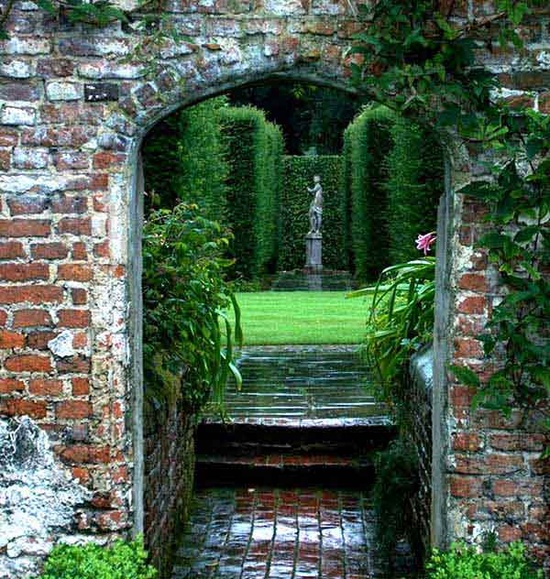
Have you ever noticed how enticing a garden gate is?


It is an anticipation of the pleasures in store, hinting at what lies beyond.  It brings to mind the book The Secret Garden by Frances Hodgson Burnett which may be the most evocative book for anyone who loves a garden and, if you were a dreamy, bookish sort as a young person when you read it (like me), one that lingers in the memory forever.


It is the transition between two spaces, the threshold into the retreat that the gardener has created.  A whiff of honeysuckle may hit us, gravel crunches under our feet, a pathway beckons us to move forward.   Expectations, garden secrets, surprises, the dazzle of a fountain, the language of flowers, the poetry of herbs all take us back to a childlike wonder as we contemplate the garden sanctuary just beyond the gate.


And there it is.  This private Eden created by the gardener.  We enter this magical spot, this outdoor room.   We are bathed in sunlight (if lucky) and inspired by color, texture, and scent.  The birds are chirping, the flowers are blooming, and the fragrance of rosemary wafts through the air.  A place to think, to dream, to reflect on the beauty of nature.  A place to count our blessings.

Photo from "Gertrude Jekyll and the Country House Garden"

This is the time of the year when gardens start to come into their own.  Garden tours will be happening all over the country.  Go here to find out about the Garden Conservancy Open Days program which allows access to more than 300 stunning properties across the country.  And if you live in Los Angeles, don't miss The Robinson Gardens Annual Garden Tour.

Visit the public gardens in your city, enjoy your own garden if you have one, or think about starting one of your own.  A small vegetable or flower garden is a great way to begin.  There are wonderful how-to books to get you started -- The Garden Primer by Barbara Damrosch is one -- and also inspiring books for the armchair gardeners out there who just want to admire --  Gertrude Jekyll and the Country House Garden by Judith B. Tankard is another.  And when you travel, be sure to find out where the gardens are.  I will never forget my trip to Paris when I was 21 and spent part of each day in a small garden on the Ile de la Cite reading my mail and writing postcards.  The time in that garden is one of the most vivid memories from the trip.  Visiting a garden will slow you down, help you recharge, and figure out what's next.

Spring is right around the corner!

First four photos via Pinterest     

Constance Spry

British floral designer Constance Spry
Photo via here

"China tea, the scent of hyacinths, wood fires, and bowls of violets -- that is my idea of an agreeable February afternoon."-- Constance Spry

A gardening friend and I have a theory.  We are fascinated with the eccentric, confident, charming, and visionary women gardeners we have read about and whose gardens we have seen.  We think there should be a book of their collected stories.  These women share so many characteristics.   Recently I learned about another irresistible figure in this field.  And I thought, oh the power of words.  One quote and a new world opens up.

But first, back to the pantheon of women gardeners she joins.  It is true that in the history of gardening and flowers there have been many outstanding women who were trailblazers.  Vita Sackvile-West, Gertrude Jekyll, Rosemary Verey, and Beatrix Ferrand are women who stand out in their field.  These were women who saw the world with fresh eyes and were able to create something new; they had the talent to turn their vision into a reality.

When I saw the above quote by British floral designer Constance Spry, I was lead on a very pleasant and instructive journey.  I needed to find out who she was.  Her words had conjured up a lovely image.  Yes, I thought, that is exactly what I would like on a February or March afternoon --  "china tea, the scent of hyacinths, wood fires, and bowls of violets."  And so I started to read about her and learned that Constance Spry was another trailblazer to add to the list. Her field was flowers and she would change the way people used them in flower arrangements forever.  Don't you love stories about strong and visionary women who were not afraid to shake things up?  A book of their collected stories would be such a good read.  

Constance Spry's flower school
Photo via here

The name Constance Spry had been familiar to me over the years, but if I am honest, mainly because of the David Austin rose named after her.  It turns out that she was an innovator in the art of flower arranging, transforming the way people looked at flowers and decorated with them in the home.  She inspired many florists in the 1930's with her natural, fluid and loose flower arrangements.  Her romantic and unconventional arrangements included garden flowers, leaves, branches, berries, grasses, and other humble items that were usually discarded at the time, but are used by florists today.  In fact, many contemporary florists cite Constance Spry as their biggest influence.  The natural and romantic flower arrangements of today that looked like they were just plucked from the garden are descendants of her work.  But in the 1930's when she was starting her flower business, the prevailing style was a tight and formal look with stiffly wired hothouse blooms.  When Constance Spry entered the scene, the public didn't know what hit them.

As I read more, I learned that in the early thirties Constance Spry created a spectacle on Bond Street when she designed a display of scarlet roses and red kale leaves for a perfumery window.  It attracted crowds so enormous that the police were brought in to control traffic.  The public was fascinated with this daring new flower designer.  Exhibiting confidence and style, she had a joie de vivre that was contagious.  She became acquainted with many artistic figures of the time, such as Cecil Beaton and Syrie Maugham and easily entered their world of flamboyant glamour.  She inspired everyone with her confidence, talent and passion.  And despite having wealthy clients, she always promoted the concept that flowers were for everyone and would demonstrate how to create beautiful arrangements with the most humble ingredients.  After a very modest childhood, her life had drastically changed and in the 1930's Constance Spry was invited to exclusive dinner parties and social events.  She became the most sought after florist in English society. Her highest honor came when she was chosen to be the florist for Queen Elizabeth II's wedding and coronation.  

One of Constance Spry's floral arrangements
Photo via here

After doing a little more research, I found out a few more things about this very interesting woman.  She was born in Derby, England in 1886 and was the oldest of five children.  Her father was a railway worker who went to night school to become an administrator in the education system.  When she was nineteen years old she enrolled in a course for health lecturers instituted by the National Health Society.  Afterwards she got a job as a lecturer and became an agent for social reform.  In Dublin where her family had moved, she met the Countess of Aberdeen who took her under her wing.  Constance joined the countess in her efforts to improve the health of the Irish poor.  She traveled through Ireland as a lecturer for the Women's National Health Association.  In 1921 she moved to London where she became headmistress at a school for impoverished children.  She ran it somewhat unconventionally, filling it with art and flowers because she believed in the healing and inspiring power of beauty on her young students.

And gardening and flowers were her true love.  She took up gardening at her house in the country and filled the rooms with her experimental flower arrangements.  She was inspired by 17th century Dutch flower paintings and her own collection of 18th and 19th century flower books.   On Mondays she would travel from her home in the country to her school in London with a basket of flowers from her garden and decorate the school with flower arrangements.   She noticed the beneficial effect the flowers had on her young students.  As more people began to see her work, she began to receive commissions for private homes and events.  She was becoming famous.  Everyone wanted to be the person who had discovered Constance Spry and pass her name on to their friends.

    
Arrangements like this by Amy Merrick, a contemporary florist who works out of New York, show the influence of Constance Spry.  Photo via here

But it was when she met theatre designer Norman Wilkinson that her life changed.  He convinced her to give up her position as head of the school and become a full-time floral designer in London.  She opened up a florist shop and flower arranging school in Mayfair and it soon became one of the most successful of its type in London.  Everyone wanted their homes decorated with Constance Spry flower arrangements and many people wanted to learn how to do it themselves.  She was the most sought after floral designer in London, receiving commissions from many famous people including the Duke and Duchess of Windsor.  She worked with interior designer Syrie Maugham (wife of the writer Somerset Maugham) and many other talented designers on their design projects.  They would not think of decorating a house, an event or a party without flowers by Constance Spry.


The Surprising Life of Constance Spry by Sue Shephard was published in 2010 and is a wonderful book about this legendary figure.


In February of 2012 Constance Spry was honored with an English Heritage blue plaque on the site of her hugely successful Mayfair shop.  Photo via here

I loved learning about Constance Spry and her belief in the healing power of beauty.  She thought that everyone would benefit from beauty in their homes and that flowers would provide it.  Her theories were meant to apply to all and she encouraged people to use wild flowers and berries plucked from their surroundings to bring beauty into their homes. She shaped the way we decorate with flowers today and wrote twelve books on the topic.  If you would like to learn more about her, read "The Surprising Life of Constance Spry."  It is a fascinating book about this amazing woman who was not afraid to shake things up and leave her mark in the field of floral design.


Blossoms


This is the time of year when we all start to yearn for spring.  Recently I hosted a lunch for my garden group and the topic was roses.  The speaker was the rose expert at the Huntington Library and Botanical Gardens and in his excellent lecture he spoke about the best roses for Southern California.  But before we heard about roses, the topic we were all discussing was the flowering pear tree.  We walked around my garden before the lecture and admired the tree which has recently burst into blossom.  It really has been a glorious sight each day and there have been moments when I have walked out the back door to see it and wanted to do a little dance "for sheer joy" just like Elizabeth did in Elizabeth and Her German Garden:

"I am always happy (out of doors be it understood, for indoors there are servants and furniture), but in quite different ways, and my spring happiness bears no resemblance to my summer or autumn happiness, though it is not more intense, and there were days last winter when I danced for sheer joy out in my frost-bound garden in spite of my years and children.  But I did it behind a bush, having due regard for the decencies.

There are so many bird-cherries round me, great trees with branches sweeping the grass, and they are so wreathed just now with white blossoms and tenderest green that the garden looks like a wedding.  I never saw such masses of them; they seem to fill the place.  Even across a little stream that bounds the garden on the east, and right in the middle of the cornfield beyond, there is an immense one, a picture of grace and glory against the cold blue of the spring sky."  -- Elizabeth Von Arnim


Even though it is not yet spring, the sight of that tree can elicit a serious case of spring fever.  There is just something so hopeful about those white blossoms against the blue of the sky.  The wind shakes the branches and the ground is carpeted in white petals.      


The British playwright and novelist J.B. Priestley, who by his own admission was a grumbler by nature, waxed poetic at the sight of spring blossoms:

"Blossom--apple, pear, cherry, plum, almond blossom--in the sun...after fifty years this delight in the foaming branches is unchanged.  I believe that if I lived to be a thousand and were left with some glimmer of eyesight, this delight would remain...At least once every spring on a fine morning... we stare again at the blossom and are back in Eden."


 On a day like this, spring does not seem very far away and I have been dipping into some of my favorite garden books for inspiration.


 I can't get enough of these inspiring stories about gardens and garden dreamers


Beverley Nichols, Vita Sackville-West, and Elizabeth Von Arnim are three of my favorite garden writers.   I love learning how the garden becomes a metaphor for finding hope and meaning in their own lives.  I also love the inspirational and how-to books on creating a garden.  My copy of Martha Stewart's Gardening is tattered from so much use.  Gardeners are often bookish types who love reading books about their passion during the winter months.  My stack of garden books is growing all the time and dipping into them on a chilly February day is one way to bring spring just a little closer.