Pink Fire Pointer Unique
Showing posts with label Bloomsbury. Show all posts

If You Happen To Be In England in October...


If you happen to be in England in the month of October, I have discovered a delightful field trip for you.  Especially for those of you who share my passion (obsession?) for Bloomsbury.  On Monday, October 22 Country Living Magazine UK in conjunction with Farrow & Ball is hosting a special day at Charleston in East Sussex, the home and country meeting place for the writers, painters, and intellectuals known as the Bloomsbury Group.  Oh how I wish I could be there!  Charleston is one of my favorite places to visit; it is a house that truly takes you to another time and place, to that era in the early twentieth-century when the bohemian group of artists and writers that included Virginia Woolf, Vanessa Bell, Duncan Grant, Lytton Strachey, and Roger Fry were gathering together to create art and write books -- all different from what had gone before -- in addition to discussing everything under the sun.  Anyone who is interested in art, decoration, gardens or history would love it. Vanessa Bell and Duncan Grant lived there and produced art together for fifty years.  All of their friends hung out there. To visit Charleston is to be transported to the incredibly exciting time of the early twentieth-century when modern art was exploding in Paris and influencing artists in England.   Being there is to understand that creativity was truly the heart and soul of the lives that Vanessa Bell, Duncan Grant and their friends lived on a daily basis.

The Lily Pond Table designed by Roger Fry and painted by Duncan Grant
It is in Maynard Keynes' bedroom at Charleston

The walled garden, the house and its interiors are magical and memorable.  The house is set in a bucolic part of Sussex, surrounded by nature and facing a pond.  The inside is a riot of color and pattern and is decorated with hand painted murals, furniture, mantels, wallpaper, textiles, fabrics, lamp shades, bed frames, and anything else you can think of.  It's an exuberant place, there are flowers and leaves in many of the designs.  These artists were inspired by the beautiful countryside that surrounds the house and the garden was often the subject of paintings done by Vanessa Bell and Duncan Grant.

Charleston has been restored and preserved so that it looks much as it must have looked one hundred years ago when Vanessa and Clive Bell moved in.   The house contains so much history and atmosphere that it feels as if Virginia Woolf might pop in at any minute to visit her sister Vanessa who is probably in the kitchen making her legendary scones for tea.   Duncan Grant may be painting in the garden and Lytton Strachey will most likely be reading in the library.  Maynard Keynes and his new wife the ballerina Lydia Lopokova may drop by to spend the weekend, as his room is always waiting for him.  He was such a frequent guest that he had his own bedroom at Charleston.  It's just above the front door and looks out on the pond.


But back to that field trip on October 22.  This is what Country Living and Farrow & Ball have planned for your day at Charleston.   After enjoying a morning coffee you will hear an informative talk about Charleston by curator Wendy Hitchmough which will be followed by a guided tour through the house and garden.  After a seasonal lunch made with local produce, you will hear a short talk about using color in the home by Joa Studholme, the international color consultant at Farrow & Ball.  After that you can take part in a painting workshop, led by artist Sophie Croyndon, to create your own Charleston-inspired wooden tray.  Doesn't this sound like a perfect day?

Eye Candy


I have been working on organizing my study, a room that has been taken over by too many books!  My study was supposed to be a room for reading and writing, an orderly room where you could find a book if you needed to or locate an article on that writer that you love.  The dream was that books would fill the book shelves and files provided with inspiration would fill the cabinets.  When we moved to our house ten years ago I unpacked a lot of things from the old house and stored them in those study cabinets, meaning to get to them one day and replace them with files, but somehow never got to it.  Ten years have passed and the files have never been made.  And books have been piling up all over the place.

A couple of weeks ago I made up my mind to begin this project.  I started by going through everything in those cabinet drawers, which included many treasures from the past:  articles, magazines, catalogues, stationary, cards, everything I had been collecting over the years.  To keep or throw away, that was the question.  The goal was to clean out the drawers and make space for the files.  Oh the amount of things I threw away!  But, there were also many treasures -- one of my favorite discoveries were the postcards and catalogues I have been collecting over the years from our travels and visits to museums, art galleries, and historic houses.  I put some of them out on my desk and I loved the collage they made.  A friend of mine described them as "eye candy."  And she was right.  I just love them!

Here are some of my favorites:

Duncan Grant, "At the Ballet" (1938) from The Bloomsbury Workshop in London

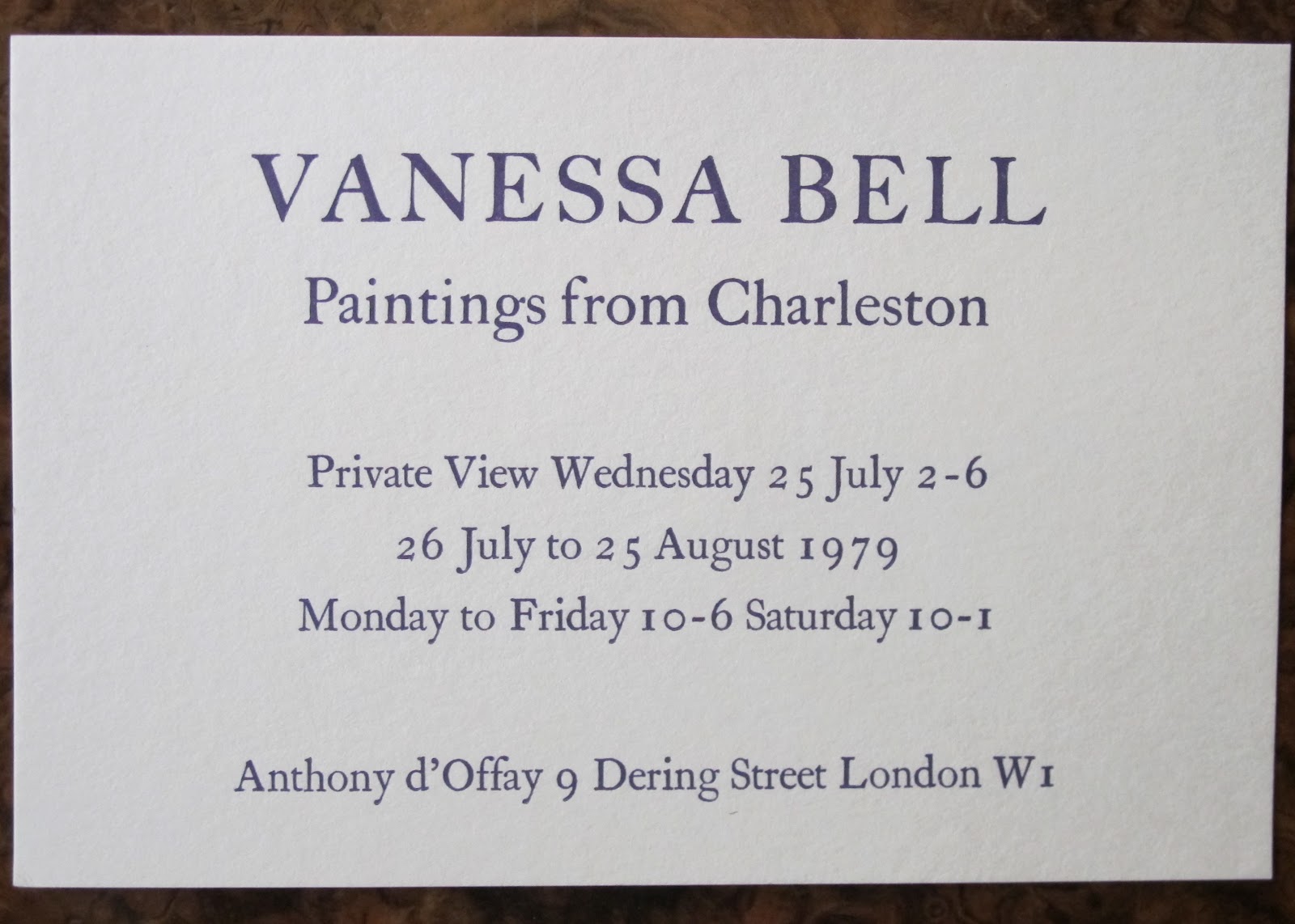
This  London gallery had an exhibition of works by Vanessa Bell, many years ago
I probably received this invitation in the mail

Vanessa Bell, "Self Portrait" (c.1958) from Charleston in Sussex, England

Catalogue for an exhibition of works by Roger Fry at The Bloomsbury Workshop

Notecard with a drawing of Knole, the ancestral home of Vita Sackville-West in Kent, England

Painting of Lady Ottoline Morrell by Simon Bussy (1920) at the National Portrait Gallery in London

The Bronte sisters, oil painting by Branwell Bronte at the National Portrait Gallery

Bloomsbury Silhouettes, 5 postcards by Anna Fewster, bought at Charleston last year

Snapshots into the past and reminders of travels and interests from many years ago -- these are just some of the souvenirs I have discovered during my adventures in cleaning up my study.  It feels a bit like a travel diary.  And there is so much more...I had no idea this would be so much fun!

Lily Pond Table


Lily Pond table
Photo via here

I am often amazed at how much I learn from my favorite blogs.  While happily reading through some recent postings on the Persephone Post, (part of their larger website which is chock-full of delightful information for book lovers) I spotted this image. It is the Lily Pond table designed and painted by British artist Duncan Grant  for the Omega Workshop around 1913.   I fell in love with this at Charleston in Sussex, England (the home of Vanessa Bell and Duncan Grant) when I visited there last September.  I learned that several of these tables were made by the Omega Workshop and that the one featured above is in an art gallery in Australia.

When I first saw the Lily Pond table at Charleston, I noticed how often the Bloomsbury artists used garden imagery in their creations.  Bringing the garden inside was something that they loved to do.  Because Charleston is in the country and surrounded by nature, it made sense that so many pieces of furniture, rugs, pillows, and wall coverings incorporated this theme.  It is one of the reasons the house is so exuberant -- flowers and leaves are everywhere.  The beautiful garden that is behind the house was often a subject of the paintings done by Vanessa Bell and Duncan Grant.

The Lily Pond table is in Maynard Kenyes' bedroom at Charleston.  He was such a frequent guest at Charleston that he was given his own room.  Can you imagine having this piece in your bedroom?  I remember that the table was in front of a window which had a beautiful view of the pond and the nearby countryside.  That side of the house would have been covered with beautiful white clematis in the summer.  It seemed like a wonderful room for sleep and a peaceful room for work.   Duncan Grant's design for the table was based on the goldfish pond in Roger Fry's garden at Durbins as seen from above.  The paint was poured in puddles, rather than carefully applied, to achieve a more free flowing effect.   After doing a little research, I wasn't surprised to find out that the Lily Pond table was one of the Omega's most popular patterns for painted furniture.


If you you love beautiful books and don't know about Persephone Books,  you should take a look at their website here. They also have two charming stores in London.   They reprint neglected novels, diaries, short stories and cookery books, mostly by women and mostly dating from the early to mid-twentieth century.  These books are beauties!  All are elegant paperbacks with a dust jacket.  They have dove-grey covers with cream labels and printed endpapers often of a fabric from the original year of publication. The books come with matching bookmarks inside.  You can buy the books on their website or if you are in London, go to their store!  The one I visited was very cozy and English, perfect for lingering and browsing through all the great titles.

A post card I bought when I was there

And by the way, I just found out that they will be publishing "A Writer's Diary" by Virginia Woolf this summer.  Something to look forward to!

Virginia Woolf
Photo via here

Endpaper for the Persephone Post edition of "A Writer's Diary"
Photo via here


A Fondness for Green

"We think we deserve some good luck.  Yet I daresay we're the happiest couple in England.
-- Virginia Woolf, after purchasing Monk's House in 1919.


I have always wanted to visit Virginia Woolf's home Monk's House, and now I feel as if I have.  Have you seen the June issue of "The World of Interiors"?  If you enjoy seeing the houses in which writers lived, you will love this article on Monk's House, Virginia and Leonard Woolf's cottage in Sussex, England.  I love seeing the places where writers lived and worked, the environments where all that creativity took place.  We can wonder, for example, which room Virginia Woolf was in when she came up with the idea for a new novel? Was she warming herself in front of the fire when she suddenly saw the main character in her mind?   How did the morning sunlight coming through the kitchen window, together with a soothing cup of tea inspire the ideas that lead to a story?  Was she daydreaming in the garden when the perfect solution for how to end a book came to her? These kinds of musings are especially relevant in the case of Virginia Woolf, since houses and their interiors have such a strong presence in her books.  As the writer of the article points out, the Woolfs adored Monk's House and lavished great time and attention on making it the very best it could be.   It was almost like the child they never had.

The house dates from the late 17th century and was lived in by millers and carpenters until Virginia and Leonard Woolf bought it at auction in 1919.  Virginia told her friends that it was an ancient Monk's house with niches for holy water, but this was an instance of her famous verbal embroidery (though there were niches on either side of the chimney); monks never actually lived there.  It is a charming brick and weather-board cottage with a large garden in the Sussex village of Rodmell.   As Virginia's books began to make money, the Woolfs were able to add amenities to the house. At one end of the house there is an extension built in 1929 that was possible because of the money Virginia earned from her novel "Orlando."  They added a studio for Virginia in the garden.  The garden was Leonard's pride and joy; he created and cared for this beautiful retreat where they spent many happy hours.

The view of the house from Leonard's Italian garden

Some of the greatest minds of the twentieth century found their way to Monk's house, including T.S. Eliot, Maynard Keynes, E.M Forster, Lytton Strachey, and Roger Fry.  Eliot told the story of the slope in the bathroom floor that made the bath water sit higher on the right.  The artists Vanessa Bell (Virginia's sister) and Duncan Grant hand-painted most of the furniture and decorative objects in the house. It is a house bursting with the personalities of the two people who lived there and, as with so many great houses, it allows us to understand them better.  "Places explain people," as David Garnett once said.

This issue of "The World of Interiors" takes us on a tour of the inside of the house and gives us a glimpse into the domestic life of Virginia Woolf.  It is a beautiful article with great photos, written by Caroline Zoob who is the last tenant-curator of Monk's House.   She tells us that Virginia "felt an irrational pain and sense of failure when her painter sister Vanessa Bell ridiculed her fondness for green."  But even though she was often influenced by her sister's artistic pronouncements, Virginia went ahead and included her favorite color in almost every room of the house.  

The sitting room at Monk's House, featuring Virginia's favorite green

The canvas-work seat of the chair in front of the writing desk in the sitting room, made by Duncan Grant's mother

The dining room with its green enamelled stove
The chairs were designed by Duncan Grant and the yellow seat backs were worked by Mrs. Grant


Virginia's sunny ground floor bedroom, surrounded by the garden.  Vanessa Bell painted the fireplace surround, signing it "VW from VB 1930."   She featured a lighthouse at the top of the tile work.


My favorite detail?  It has to be Virginia's Shakespeare collection which she bound in colorful papers.  In 1936, she wrote to E.M. Forster that she was "rebinding all my Shakespeares - 29 volumes - in coloured paper," labelling the spines herself.

 Lady Ottoline Morrell gave Virginia the Chinese silk shawl which is draped on this chair in her bedroom.  Virginia would write here using a board which would sit upon the chair's arms.  

Virginia's Shakespeare collection rebound by her "in coloured paper" -- it almost looks marbleized.
How beautiful!

Virginia Woolf's fondness for green is just one of her personal preferences that we can see in the way she decorated her home.  Pick up this issue of "World of Interiors" to see all the gorgeous photos of her charming Bloomsbury retreat and to read the fascinating article. (Photos by Caroline Arber and text by Caroline Zoob)   Notice how personalized everything is --  her hand or that of her sister Vanessa is responsible for almost everything.  Her approach to decorating this country cottage reveals a time and a sensibility when most things were hand decorated and this approach to making a home was the welcome relief she needed from writing her books.  Her friends enjoyed being at Monk's House and many of them wrote about it:  

"I loved the untidy, warm, informal nature of the house with books and magazines littered about the rooms, logs piled up by the fireplaces, painted furniture and low tables of tiles designed by the Bloomsbury artists, and writing done in sunny, flower-filled , messy studios.  A smell of wood smoke and ripe apples lingered about it, mixed with the fainter under-perfume of old bindings and old paper."
-- John Lehmann

It sounds like a wonderful environment for inspiration.  And now I can picture Virginia sitting in that chair in her bedroom with Ottoline's scarf wrapped around her shoulders writing one of her books.  With Shakespeare nearby to guide her, she was in a great space to unleash her creativity.

Angelica Garnett: December 25, 1918 - May 4, 2012

Angelica Garnett at Charleston, the Sussex farmhouse where she was born.  A bust of her aunt, Virginia Woolf, stands on the right.  Photo by Jane Brown via here

I was saddened to read that Angelica Garnett died on May 4 in the South of France.  She was 93.  She was born on Christmas day in 1918 at Charleston Farmhouse, the Bloomsbury Group's country retreat in Sussex, England.  She was the daughter of the artists Vanessa Bell and Duncan Grant and the niece of writer Virginia Woolf (Vanessa Bell's sister).  Vanessa married the art critic Clive Bell in 1907 and they had two sons, Quentin (1908) and Julian Bell (1910). Angelica was born in 1918 and grew up believing that Clive Bell was her father, until Vanessa enlightened her at the age of 18 that Duncan Grant was actually her father.  Angelica wrote about her struggle to deal with the psychological issues that she associated with her upbringing in the book "Deceived with Kindness."  Angelica Garnett was the last direct link to the Bloomsbury group.

Angelica Garnett with her aunt Virginia Woolf
Photo via here

Charleston was Angelica's home until she married in 1942.  She was 23 when she married the writer and publisher David Garnett, then nearly 50.  They divorced after 25 years of marriage.  As a young woman she briefly studied drama in London, but decided not to pursue it and instead became a painter like her mother.   She wrote two memoirs and was the mother of four daughters.  Sadly her life was greatly affected by her lack of a real father, since she and Duncan Grant together never acknowledged their real relationship.  It was only when she wrote her memoirs that she gained some amount of closure and comfort on this topic.  She wrote frankly about her upbringing and also captured some of the idyllic qualities of growing up at Charleston,  describing how life at Charleston seemed bathed "in the glow of perpetual summer."  Her writing brought her satisfaction and she experienced a sense of accomplishment with the publication of these memoirs.    

Charleston Farmhouse
Photo via here

Perhaps her greatest legacy was the restoration of Charleston Farmhouse, the house where she and her brothers grew up with her parents Vanessa Bell and Duncan Grant.  Vanessa and Duncan lived and produced art together there for 50 years.  Clive Bell also lived there at times and many of the Bloomsbury Group visited for extended stays.  Virginia and Leonard Woolf lived at Monk's House which is a short distance away and were frequent guests.  Maynard Keynes had his own room at Charleston.

The Charleston Trust has released a statement about Angelica's death saying that she was actively involved in the acquisition and restoration of the house and its contents.  After Duncan Grant's death in 1978, Angelica returned to live at Charleston and this was when her involvement began.  Her parents had decorated the walls, mantelpieces, and furniture of the house with their distinctive designs, but the house had fallen into disrepair.  Lovingly restored to its original condition and opened to the public in 1986,  Charleston Farmhouse is a wonder to see.  The house is the incredible creation of two remarkable artists -- Vanessa Bell and Duncan Grant -- and every room of the house is bursting with color, pattern, texture, and happy design.  The restoration of it and opening to the public was a gift to the world.  The appearance of the house and collection today is the result of Angelica Garnett's generosity and that of her brother and sister-in-law Quentin and Olivier Bell.

The Garden Room at Charleston, decorated by Vanessa Bell and Duncan Grant.   A painting of Vanessa Bell by Duncan Grant hangs on the left wall.  Photo via here

Angelica's parents were deeply bonded over their art and created much art together at Charleston throughout their lives. They decorated the house with murals, painted furniture, fabrics, rugs, and ceramics, all of which they designed.  They painted mantelpieces, designed needlepoint rugs, pillows and wallpaper.  All of it fills the house and gives off a feeling of joyousness.  I have visited Charleston twice and I urge you to go if you ever have the opportunity.  To visit there is to be transported to the bohemian environment of Angelica's parents and to understand that art was truly the heart and soul of the lives that Vanessa Bell and Duncan Grant lived there on a daily basis.   To see Charleston is to get a glimpse of "Bloomsbury" at home.  This modest home bursting at its seams with art and its lovely garden feel like an enchanted place.

Duncan Grant's art studio at Charleston.  Photo via here

Angelica Garnett at Charleston.  Photo via here


"It is always an adventure to enter a new room; for the lives and characters of its owners have distilled their atmosphere into it, and directly we enter it we breast some new wave of emotion.."  Virginia Woolf,  "Street Haunting"

Virginia Woolf could have been writing about Charleston.  Certainly "the lives and characters of the owners have distilled their atmosphere into it."  Throughout her life Angelica Garnett was a passionate supporter of Charleston, most recently donating over 8000 works by Duncan Grant and Vanessa Bell to The Charleston Trust.  She worked devotedly to make this home accessible to the public so that we could understand how special and unique a place it is.  We can be thankful to her for the restoration of Charleston and the opportunity she has given us to visit it today.  The Charleston Trust released a statement saying that Angelica's most recent visit to Charleston was in April 2012 when she attended the opening of an exhibition of her recent work donated to support the Charleston Centenary Project.  She was actively engaged in writing her autobiography at that time.

Angelica Garnett will be missed.        

Behind the Scenes at the Courtauld Gallery

A new rug by Christopher Farr inspired by a design from the Omega Workshop, photo via "Elle Decor"
I saw the original Omega design at the Courtauld Gallery 

Somerset House, the home of The Courtauld Gallery in London

Did  you know that if you want to see an art work at the Courtauld Gallery that is currently not being exhibited, you can make an appointment with a curator and go behind the scenes to see it?  This is what I did on my recent trip to London, and it was one of the highlights of the trip!


It all started with the October issue of Elle Decor.  I was browsing through it while still in Los Angeles and was stopped in my tracks by an article called "Charmed Circle:  A new collection of rugs based on their designs proves that for the artists of the Bloomsbury group, the home was a compelling canvas."

It turns out that Christopher Farr Rugs, located in London and Los Angeles, is issuing limited editions of rugs based on five designs created by Bloomsbury artists for the Omega Workshop.  The Omega Workshop was founded in London in 1913 by artist and art critic Roger Fry as an enterprise that would allow his fellow Bloomsbury artists  to design furniture, textiles, rugs, ceramics, lampshades and other home accessories in the same spirit of modernism that they were displaying in their art work.  The Bloomsbury artists Vanessa Bell, Duncan Grant and Roger Fry were greatly influenced by the developments occurring in the art world of Paris in the early twentieth-century.  In fact, they were responsible for bringing works by these European artists, such as Cezanne, Matisse and Picasso to London and thus introducing the age of modernism to England.  At the same time, their own work was greatly affected by what they saw in Paris.

Being a forward thinker, Roger Fry was also anxious to bring this spirit of modern art to the world of home decor.  And so the the Omega Workshop was born as an atelier in the Bloomsbury neighborhood of London, a place where these artists were given the opportunity to design home furnishings with the same free hand that they brought to their bright, expressive paintings. 


Charleston Farmhouse in Sussex

I was in just in London a couple of weeks ago and had the opportunity to visit Charleston in Sussex, the country home of Vanessa Bell and Duncan Grant.  Our tour guide pointed out many objects in the house that had come from the Omega Workshops -- the chairs around the dining room table, a "Lily Pond" table in Maynard Keynes room, and several different fabric designs that were designed by Bell and Grant. 


Duncan Grant's studio at Charleston, his country home that he shared with Vanessa Bell.  Many of the items in Charleston were designed by the Omega Workshop.  Photo via "Elle Decor"

A Farr rug with a design attributed to Vanessa Bell, photo via "Elle Decor"


A Christopher Farr Omega design in Hand-knotted wool and mohair, photo via "Elle Decor"
I saw this original design at the Courtauld Gallery

According to the article in Elle Decor, these designs were at the Courtauld Gallery and since I was going to London I made up my mind to seek them out.  So one of the first places I went when I arrived in London was the Courtuald to search for these designs.  I couldn't find them and when I asked a young woman for some assistance she told me they were not out at the moment.  But would I like to make an appointment to return at a later date to see the pieces.  Yes, I would!  So on a Thursday afternoon I had an appointment at the Courtauld to see some of the Omega designs.  I was able to take a few photos as long as there was no flash,  but unfortunately my flash started going off and I was unable to snap the photos of the two designs that I did see for the rugs that Christopher Farr has brought out.  


When we arrived we were met by the charming assistant who had set up our appointment.  We were then taken to the display room of the storage facility at the Courtauld where a Bloomsbury scholar brought out about twenty works for us to see.  


We were given magnifying glasses to see these rug designs closely


Rug design from the Omega Workshop


Rug designs from the Omega Workshop


Rug design from the Omega Workshop

This hour spent behind the scenes at the Courtauld Gallery with a curator who shares my love of the Bloomsbury Group was one of the best of my trip.  In addition to seeing some of the treasures of this art museum, I got to chat with a lovely American scholar about all things Bloomsbury.  It was truly a highlight of my visit to London.  Now I cannot wait to see the actual rugs at Christopher Farr!


Duncan Grant and Bloomsbury

"Bathing" by Duncan Grant, 1910

The English poet Stephen Spender wrote about Duncan Grant, "I can think of no painting by him in praise of landscape or nude or flowers or still life or scene from mythology which is not also joyful and light in execution."  Who was Duncan Grant?  He was a talented British artist who painted many pictures during his lifetime (1885-1978), including "Bathing" in 1910 and "Crime and Punishment" in 1909.  His works hang in the Tate Gallery and The National Portrait Gallery in London, just to name a few places where you can find his art.

"Crime and Punishment," by Duncan Grant, 1909

He was painting in England during the same time period that Matisse, Picasso, and Cezanne were painting in Paris, the years before World War I.  He was part of the art movement in London that brought these post-impressionist artists to the attention of the English public in 1910.  His fame as an artist was greatest during the years between the two world wars.  He was co-director of the Omega Workshops, founded by Roger Fry, an enterprise that allowed artists the opportunity to design decorative arts, including furniture, fabrics, and wallpaper, and consequently earn extra income.

Design for embroidered fire screen, 1912, by Duncan Grant

He loved the artist Vanessa Bell, sister of Virginia Woolf, and lived with her at Charleston Farmhouse in Sussex, England where they produced art together for 50 years.  They also decorated the walls, mantelpieces, and furniture of the house with their distinctive designs.  And he was a member of the Bloomsbury group.  From the many stories that the various members have told, one gets the feeling that Duncan Grant was beloved by all.  

"Portrait of Vanessa Bell" by Duncan Grant, 1917-1918

Recently I was asked to write a guest post for the art blog "A Husk of Meaning."  I chose to write about Duncan Grant. I am posting it today on my blog for those of you who may not have seen it.   I hope I can shed some light on an artist whom I admire and of whom many people are unaware.

Duncan Grant, 1925

"Self-Portrait in a Mirror" by Duncan Grant, 1920

Born in 1885 in the Scottish Highlands, Duncan Grant was introduced to the friends who became known as the Bloomsbury Group through his first cousin Lytton Strachey.  Lytton was at Cambridge University and there he met a group of bright young men which included Thoby Stephen, Leonard Woolf, Clive Bell, and Maynard Keynes.  These friends, along with Vanessa and Virginia Stephen (who became Vanessa Bell and Virginia Woolf), formed the nucleus of the Bloomsbury Group.  Duncan quickly became a well-loved member of this group of intellectuals and artists.

"Lytton Strachey" by Duncan Grant, 1909


"Portrait of Vanessa Bell in an Armchair," by Duncan Grant, 1915

Duncan's friendship with the French painter Simon Bussy influenced him to attend art school.  He decided to study in Paris with Jacques-Emile Blanche during the years 1906-1907.  He loved France and later he and Vanessa Bell would spend part of each year at a house in Cassis.  Many of his landscapes at this time were done in Cassis and neighboring towns.  He began to be influenced by the post-impressionist painters, especially Picasso and Matisse.

"Dance" by Matisse

"Purple Robe and Anemones" by Matisse

Today we can only imagine what it must have been like to be an artist in England, or anywhere for that matter, and know what was going on in the art world in Paris in the early part of the twentieth-century.  Picasso, Matisse, Cezanne, and others were revolutionizing art.  It must have been a thunderbolt of revelation to artists such as Duncan Grant and Vanessa Bell.   For the most part the English public were unaware of the enormous developments that were happening in the arts in Paris.  Roger Fry, an art historian, critic and friend of Vanessa and Clive Bell, wanted to change that. He organized the exhibition "Manet and the Post-Impressionists" at the Grafton Galleries in London in 1910.  (Roger Fry invented the term "post-impressionism.")  The show was monumental.  Many people hated it but it had a tremendous impact on artists such as Duncan Grant and Vanessa Bell.  Many art historians feel that this show was the beginning of modernism in the arts in England.

The paintings by Duncan Grant, pictured below, are thought to show the influence of the post-impressionist artists that he would have been seeing at the time.

"Still Life, The Mantelpiece" by Duncan Grant, 1914


"The Dancers" by Duncan Grant, 1911

"Venus and Adonis" by Duncan Grant, 1919

"The Tub" by Duncan Grant, 1913

"Interior, 46 Gordon Square" by Duncan Grant, 1914 

When Vanessa Bell bought Charleston Farm in Sussex in 1916 she moved there with her two boys. Duncan Grant joined her there.  They produced much art together over the course of 50 years, as well as decorated the house with murals, painted furniture, fabrics, rugs, and ceramics.  It has been restored and is open to the public.  To visit there is to be transported to the bohemian environment that was theirs and to understand that art was truly the heart and soul of the lives that Vanessa Bell and Duncan Grant lived on a daily basis.

"Interior with Duncan Grant," 1934 by Vanessa Bell
This shows Duncan Grant in his studio at Charleston

Charleston Farmhouse

Garden Room at Charleston, decorated by Vanessa Bell and Duncan Grant

 Garden Room at Charleston

Door of Duncan Grant's bedroom, designed and painted by Vanessa Bell

When I think of my favorite works by Duncan Grant, I consider his landscapes, his interiors, his still life paintings, his decorative work, and his works that were considered especially outstanding, such as "Bathing" and "The Dancers." Most of them express the exuberance and joy that I associate with Duncan Grant, the artist and the person.  There is a lyricism, spontaneity, and sensuousness to his work that many critics have observed.  I admire all of them.  But my favorites, the ones that I always want to see are the portraits, like this one:

"Portrait of Chattie Salaman" by Duncan Grant, 1942

The portraits live for me; they have a vivid presence, are informal and relaxed, and are often set in charming interiors which include decorative elements such as fabric, furniture, ceramics or murals which were designed by Duncan or Vanessa. The portraits often depict warm environments and also give warmth to the rooms in which they hang.  They portray so many of the people I have read about through my interest in Bloomsbury.  Duncan was engaged with that world of people and art and his portraits reflect the world of his friends.  We can picture this gentle, charming, and handsome man easily persuading his friends to sit for him.  For me the portraits are some of his most satisfying art works.

I think that Roger Fry captured the distinctive qualities of the artist's work when he wrote about Duncan in his book "Duncan Grant," published by the Hogarth Press in 1923:

"He pleases because the personality his work reveals is so spontaneous, so unconstrained, so entirely natural and unaffected.  And these happy dispositions of his nature reveal themselves in his work -- in his drawings by a singularly melodious and rhythmic line, in his painting by a corresponding fluency and elegance of handling.  His naturalness gives him his singular charm of manner.  But more than this, he has a peculiar happiness of disposition.  A certain lyrical joyousness of mood predominates in his work.  And this leads him to affect and enjoy what is beautiful in nature, and to express that delight in beauty in his work."